born at 321.89 PPM CO2

Credit is due to René Magritte, Man Ray, Salvador Dalí and Leonora Carrington, whose extraordinary work has inspired many of the images featured throughout this blog.

Sunday, 5 June 2022

(AUC) BEHOLD - THE POLESTAR 2 BST EDITION 270

Polestar is returning to its sporting roots with a hot new range-topping version of the 2 electric saloon.

First revealed as an experimental prototype at last year's Goodwood Festival of Speed, the new Polestar 2 BST Edition 270 is the Swedish brand's "most dynamic electric driver's car yet".

Aside from the obvious bespoke design elements, which clearly mark this out as the sportier car, the four-wheel-drive BST has been tuned to give total outputs of 469bhp and 502lb ft as standard - matching a recent power boost that was recently rolled out as an over-the-air upgrade for the standard 2, making it good for 0-62mph in 4.2 seconds.

On top of that, Polestar has lowered the ride height by 25mm and installed two-way adjustable Öhlins dampers, 20% stiffer springs and a new front strut bar in the name of improved handling. The bespoke 21in matt black wheels are wrapped in specially developed Pirelli P Zero tyres.

Power is still served up by a 78kWh battery under the floor, offering a range of around 292 miles.

Available in either grey or white and with a 'Charcoal Weavetech' interior, the BST is decorated with a fully colour-coded body kit and an optional matte black racing stripe running front to back. Subtle gold detailing for the brake calipers, tyre valve caps and seatbelts harks back to the Polestar Engineered variants of certain Volvo models that the brand created before being hived off as a standalone entity.

The new special edition will enter production in mid-2022, ahead of deliveries getting under way in the final quarter of the year. As the name suggests, just 270 units will be produced, to be distributed exclusively in the US and Europe. Autocar - link - the ever brilliant Felix Page - link - more like this (electric cars) - link - more like this (Sweden) - link

Saturday, 4 June 2022

(HFN) DESERTS, DESALINATION & GREEN HYDROGEN

Desert regions could gain potable water from green hydrogen projects, says IRENA. The desalinization process increases the levelized cost of H2 by under 4 percent, said the agency.

Green hydrogen projects in desert regions using desalinization to provide the H2 production with water could also be used to boost potable water levels for the people living there, according to a new International Renewable Energy Agency (IRENA) report.

This is promising for countries including Saudi Arabia, Namibia, Oman, Chile, Mauritania, and Australia.

Each of those countries has a plan to install multi-gigawatt green hydrogen projects in their arid regions. These areas are appealing due to the long hours of full sunshine that are well suited to producing ample solar electricity to power the water electrolysis machine to produce the renewable H2. The equipment is used to split water molecules into H2 and O2.

“A challenge for Africa is water scarcity, but green hydrogen could provide an opportunity to tackle this challenge instead of aggravating it,” said the IRENA study. “Even for low LCOH [levelized cost of hydrogen] scenarios, water supply, in the most conservative case, through desalination, represents only less than 4% of the total LCOH, which means it is relatively cheap when compared with the hydrogen supply.”
The water desalinization for green hydrogen could be broadened to cater to other water uses.

“The water supply system could be expanded to cater for other water uses (eg, sanitary) at a relatively small cost penalty for the hydrogen but providing the economies of scale needed to achieve low water costs,” said the IRENA report, which also stated that it would be affordable to pipe the desalinated water inland.

“Even in regions far from the coastline, water transport could be considered, which will increase the cost of water supply, but it will still represent a relatively small share of the total hydrogen production cost, reaching levels of $0.05/kgH2 and representing 1-2% of the energy consumption of the electrolyzer,” added the report.

In this way, producing green hydrogen has the potential to solve an additional problem beyond making clean energy and boosting a local economy. At the same time that the greenhouse gas emission-free fuel is being made, usable water for the surrounding area will also be made available without adding a considerable additional expense to the H2 production. Hydrogen Fuel News - link - Julie Campbell - link - more like this (H2 fuel) - link

(ENM) USERS, DEALERS AND MINERS - PART 3

A  worker checks parts for battery packs at a factory belonging to Sunwoda Electric Vehicle Battery in Nanjing in east China’s Jiangsu province in March 2021. (Photo by Feature China/Future Publishing via Getty Images)

The US government announced in early May that it will provide more than $3bn to boost domestic production of electric vehicle (EV) batteries. The proposal was announced as the US car industry pivots to meet President Joe Biden’s goal for half of vehicle sales in the country to be electric by 2030.

However, electrifying the US car fleet could yet prove challenging, as experts warn of a gap between future production and demand for the critical minerals needed for EV batteries. Electric car sales are booming, but scaling up mining in the short term is difficult: on average, it takes 16.5 years to take a new mine from planning to production.

Additionally, most minerals needed for EVs are produced in a handful of countries, making the supply chain vulnerable to price volatility and disruptions.

That is why the Biden administration also announced a separate $60m programme for battery recycling in early May 2022. By reusing materials from end-of-life batteries, a secondary domestic supply chain independent of the mining supply chain could be created.

According to US-based analysts Allied Market Research, the global EV battery recycling market was valued at around $139m in 2017 and is expected to grow to $2.27bn by 2025.

The need for independence and security of supply has become more urgent since Russia invaded Ukraine – the first halts to gas deliveries to Poland and Bulgaria, and most recently Finland, have had countries scrambling for alternatives. A month before announcing the $3bn EV battery boost, Biden already invoked the Defense Production Act to increase the mining of EV battery minerals.

This gives the government more access to funding to support mining, processing and recycling of critical minerals. According to the US Geological Survey, the country had a net import reliance of 100% for graphite and manganese in 2021, followed by 75% for cobalt, almost 50% for nickel and more than 25% for lithium. Energy Monitor - link - Isabeau van Halm - link - more like this (USA) - link - users, dealers and miners - link

(KYI) RUSSIA'S 31,050 REASONS TO END THE WAR


A Ukrainian serviceman stands in front of a gas station as it burns following a Russian attack on Kharkiv on March 30. (Getty Images)

As of June 4, Russia has lost around 31,050 troops, 1,376 tanks, 3,379 armored vehicles, and 680 artillery systems, as well as 210 planes and 175 helicopters, since the beginning of the country’s full-scale attack on Feb. 24. 

kyivindependent - link - photos - Kostyantyn Chernichkin - link - more like this - link

Friday, 3 June 2022

(WEV) STEEL ZERO

Volvo Cars has become the first car maker to sign up to the SteelZero initiative, which aims to tackle carbon emissions produced by the steel industry.

Steel production is responsible for around seven per cent of all global greenhouse gas emissions and is a major contributor to the C02 emissions produced by the automotive industry. Currently, around 33 per cent of all emissions produced while making a Volvo car are from producing the steel parts.

By joining the scheme, Volvo, which has previously announced its intention to be carbon neutral by 2040, has committed to sourcing all net-zero steel by 2050.

Between now and 2040, Volvo aims to reduce the lifecycle carbon footprint per car by 40 per cent between 2018 and 2025. Its manufacturing processes and plants are powered by clean energy, and it is targeting a carbon emission reduction in its supply chain of 25% by 2025 to achieve this. Volvo Cars also looks to become a fully electric car maker by 2030, further reducing the climate impact of its vehicles.

Volvo Cars Chief Procurement Officer, Kerstin Enochsson, said: “We are pleased to join the SteelZero initiative and support its ambitions to transform the steel industry. By signalling our demand for responsibly sourced low- and zero-carbon steel, we aim to help drive an increased supply to our sector.”

SteelZero was launched in 2020 by the Climate Group. It was created in partnership with ResponsibleSteel, a steel industry-wide standard and certification body which Volvo Cars will also join.

According to the company, ResponsibleSteel will give Volvo Cars access to reliable, third-party-verified and audited information about its steel supply chain and relevant sustainability credentials, to help ensure it is responsibly sourced.

As well as CO2 reductions, ResponsibleSteel investigates other potential issue areas along the steel supply chain such as labour and human rights, engagement with local communities, water use and biodiversity impact.

Jen Carson, Head of Industry at Climate Group, said: “Volvo Cars joining SteelZero marks an important step change in the global demand signal for low-emission and net-zero steel, and a pivotal moment for the automotive industry. This sector plays a central role in driving the net-zero transition of steel. It is supporting the creation of a decarbonised steel market internationally that can enable the sector to meet its own net-zero targets and deliver a product that is truly aligned with the climate agenda.”

In Volvo’s push for decarbonising its steel, last year it announced it was working with Swedish steel maker SSAB to explore the development of fossil-free, high-quality steel for use in the automotive industry through SSAB’s HYBRIT initiative.

HYBRIT aims to replace coking coal, traditionally needed for iron ore-based steelmaking, with fossil-free electricity and hydrogen. If successful, it could be the world’s first fossil-free steelmaking technology, with almost no carbon footprint. WhichEV - link - Isabella McCrone - link - more like this (Sweden) - link

(TCR) NEVADA SOLAR

There’s an idea floating in the ether (or at least in my ether) that there’s enough sunny federal land in Nevada to power the entire United States with solar.

Some very rough back-of-the-envelope math suggests it’s possible, requiring just over 11% of Nevada’s federal land. None of that includes room for batteries for storage or the massive transmission wires needed to export it all — both of which would expand the footprint significantly — and a concentrated installation like that wouldn’t be very resilient or ecologically sound.

The point is, there’s room to spare! The federal government owns plenty of land in other sunny and windy places, not just Nevada.

TechCrunch on Guff House - link - Tim De Chant - link - more like this (solar) - link

(REU) CHINA TARGETS 33% RENEWABLES BY 2025

Workers walk at a solar power station in Tongchuan, Shaanxi province, China December 11, 2019. Picture taken December 11, 2019. REUTERS/Muyu Xu

SHANGHAI, June 1 (Reuters) - China will aim to ensure that its grids source about 33% of power from renewable sources by 2025, up from 28.8% in 2020, the state planning agency said on Wednesday in a new "five-year plan" for the renewable sector.

China's total renewable energy consumption is set to reach about 1 billion tonnes of standard coal equivalent (TCE) by 2025, as the country bids to raise the share of non-fossil fuels in total energy use to 20%, the National Development and Reform Commission (NDRC) said.

Non-fossil fuels accounted for 15.4% of total primary energy consumption in 2020.

China, the biggest source of climate-warming greenhouse gases, has pledged to raise total wind and solar capacity to 1,200 gigawatts by 2030, almost double the current rate, with plans to build large-scale renewable energy bases in northwestern desert regions.

Climate groups were hoping that China would set a strict energy consumption target for 2025 as it prepares to bring total greenhouse gas emissions to a peak before 2030.

Though China has yet to announce a formal energy cap, the new non-fossil fuel energy consumption figure implies that total primary energy use could reach 5 billion tonnes of standard coal by 2025.

The NDRC said renewables would account for more than half of new energy consumption growth from 2021-2025 period, but China still has leeway to build more fossil fuel-fired power plants over the period as it focuses on improving energy security.

China is aiming to start cutting coal consumption in 2026, but in the meantime could put as much as 150 gigawatts of new coal capacity into operation by then, according to research from the State Grid. read more - Reuters - link - David Stanway - link - more like this (China) - link

(THU) DECARBONISED DECARBONISERS

One of the many complaints we hear about wind turbines from fossil fuel fans is that turbines have a high carbon footprint—thanks in part to the steel in their towers—so it is counterintuitive to invest in them. U.S. President Joe Biden's notorious predecessor once complained

"The fumes coming up, if you are a believer in carbon emission, the fumes coming up to make these massive windmills is more than anything we are talking about with natural gas, which is very clean." In fact, life cycle analyses give wind turbines a carbon footprint averaging 11 grams per kilowatt-hour—30% of which comes from the steel tower. (Natural gas is 450 grams per kilowatt-hour just from combustion.)

Now, Stora Enso, one of the world's oldest and largest timber companies, is working with Swedish tower builder Modvion to build wind turbine towers out of laminated veneer lumber (LVL). Otto Lundman, CEO of Modvion, said in a statement: “To solve the climate crisis, we need more renewable energy as well as increased use of sustainable, wooden constructions. Together with Stora Enso, we can enable both.”

Treehugger covered the Modvion timber turbine towers a few years ago when it was at the early prototype stage, but the project has advanced significantly. Modvion completed a 30-meter (100-foot) prototype in 2020 and is now working on a 100-meter (330-feet) tower for Varberg Energi. It is now turning out giant curved slabs of LVL that will be glued together into tubular sections on site. This is a major advantage over steel towers, which are usually giant cylinders that are hard to transport and don't fit under bridges.

The Stora Enso-supplied Scandinavian spruce is certified under FSC (Forest Stewardship Council) or PEFC (Programme for the Endorsement of Forest Certification) standards. The carbon emission savings are significant: Modvion states the life cycle emissions of a 360-foot steel tower are about 1,250 metric tons of carbon dioxide (CO2) while a wood tower has 90% fewer emissions, at 125 metric tons.

And that is without taking credit for any carbon storage in the wood, which they account for separately:

"Considering that the wood tower also stores carbon dioxide, the tower’s actual climate impact is lower. A wooden construction stores approximately 1.8 tonnes of carbon dioxide per tonne of wood. A 110m tall tower weighs 180–300 tonnes, depending on the size of the turbine being supported. This means a carbon dioxide storing capacity of 540 tonnes and a net climate impact of minus 300–400 tonnes of carbon dioxide."

As we mention every time we talk about wood, the question of how much CO2 is stored in wood construction is controversial. The CO2 savings from replacing steel are not, and they reduce the lifecycle operating costs of the wind turbine by 30%.

Modvion describes how strong LVL towers are, cleverly calling laminated wood "nature's own carbon fiber, which is stronger than steel at the equivalent weight." They also note wood towers don't have 50,000 steel bolts that all have to be inspected:

"Laminated wood has three huge benefits compared to steel: Wood has a higher specific strength which enables a lighter construction. High steel towers need extra enforcement to carry their own weight—which wooden towers don’t need. And finally, modular steel towers demand a vast number of bolts that need regular inspections while our modular wooden towers are joined together with glue."

One would think wood towers would need regular inspections too, especially when it comes to issues of moisture. Modvion explains its towers are coated with a thick paint that makes them watertight. It adds, "This creates a controlled volume of air on the inside that interacts with the solid wood volume. The stable system keeps a healthy margin towards any humidity issues."1

Treehugger - link - Lloyd Alter - link - more like this (wind turbines) - link - more like this (Sweden) - link

(GUA) TYRE POLLUTION OVERTAKES EXHAUSTS

Emissions from tailpipes in developed countries are much lower in new cars, with those in Europe far below the legal limit. Photograph: Jacob King/PA

Almost 2,000 times more particle pollution is produced by tyre wear than is pumped out of the exhausts of modern cars, tests have shown.

The tyre particles pollute air, water and soil and contain a wide range of toxic organic compounds, including known carcinogens, the analysts say, suggesting tyre pollution could rapidly become a major issue for regulators.

Air pollution causes millions of early deaths a year globally. The requirement for better filters has meant particle emissions from tailpipes in developed countries are now much lower in new cars, with those in Europe far below the legal limit. However, the increasing weight of cars means more particles are being thrown off by tyres as they wear on the road.

The tests also revealed that tyres produce more than 1tn ultrafine particles for each kilometre driven, meaning particles smaller than 23 nanometres. These are also emitted from exhausts and are of special concern to health, as their size means they can enter organs via the bloodstream. Particles below 23nm are hard to measure and are not currently regulated in either the EU or US.

“Tyres are rapidly eclipsing the tailpipe as a major source of emissions from vehicles,” said Nick Molden, at Emissions Analytics, the leading independent emissions testing company that did the research. “Tailpipes are now so clean for pollutants that, if you were starting out afresh, you wouldn’t even bother regulating them.” The Guardian - link - Damian Carrington - link - more like this (pollution) - link

(LET) COUNCIL HALTS TERRACYCLE TRIAL

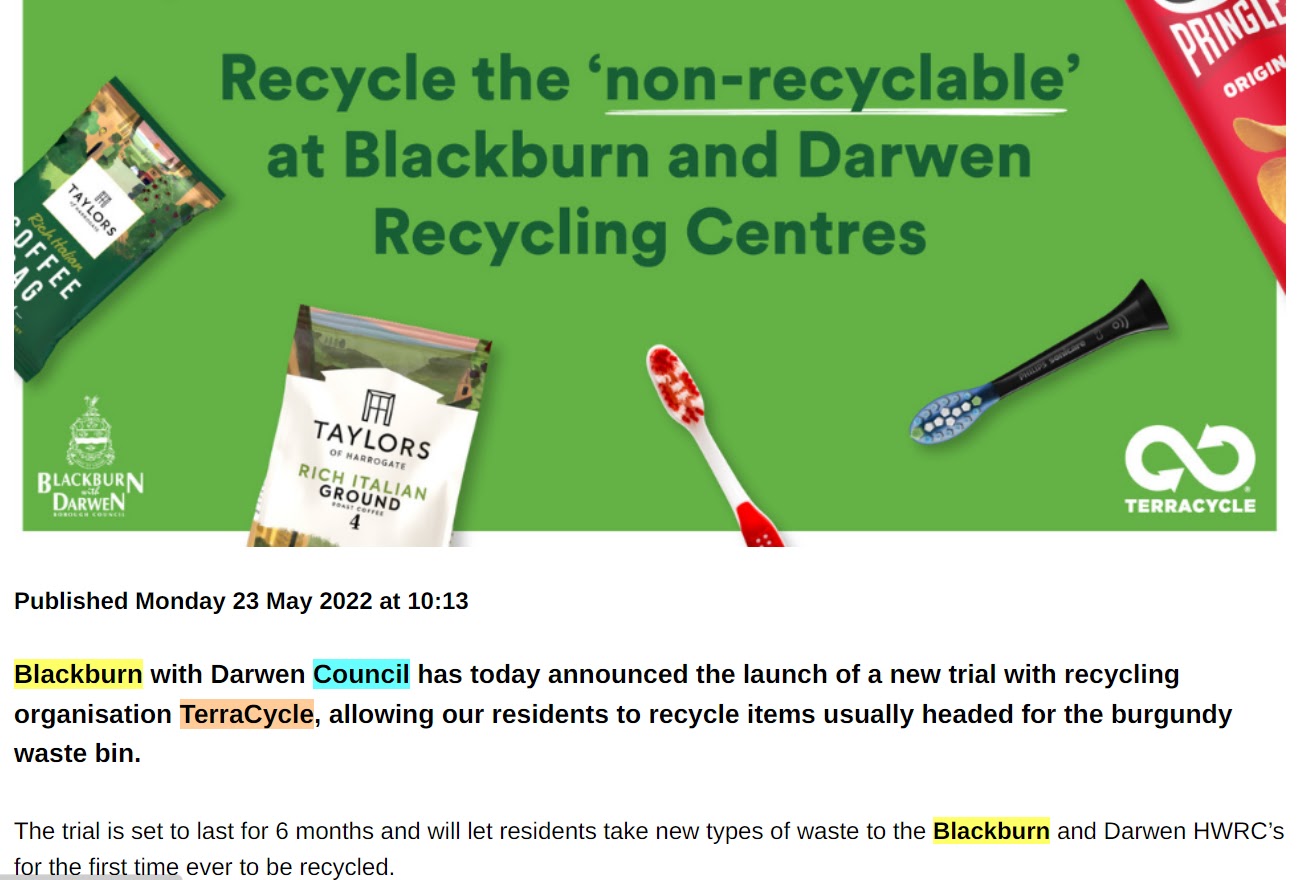
EXCLUSIVE: Blackburn with Darwen council has halted a trial collection service with Terracycle in light of a BBC documentary questioning the scheme’s efficiency.

The Lancashire local authority is thought to be the first to make such a move, with the webpage detailing information about the trial pulled while the Panorama programme was on.

The trial, which was launched on 23 May, was supposed to last for six months. Residents were being given the opportunity to recycle ‘hard-to-recycle items’ such as biscuit wrappers, Pringles tubes, plastic toothbrushes and coffee bags.

These are not included in the council’s kerbside collection because of difficulties and costs associated with recycling complex materials.

The trial would have seen residents drop off bags of these items at their local household waste and recycling centres (HWRCs) to then be recycled by Terracycle.

However, Stuart Hammond, environmental and sustainability manager at Blackburn with Darwen council, explained to letsrecycle.com that the council had decided to halt its trial while the BBC One programme was on.

It is currently waiting to get clarity from its waste contractor Suez and Terracycle on whether they want to continue the trial. Mr Hammond added that the council would like for the trial to reopen. Suez has a 30% stake in Terracycle in Europe.

The news was confirmed by Tony Watson, head of environment for Blackburn with Darwen Council, who said: “We will always do everything we can to encourage residents in Blackburn with Darwen to recycle. The Council, like many others across the country, has declared a Climate Emergency, and recycling is one of the many ways residents can help us work towards being carbon neutral. 

After being made aware of the impending BBC documentary, we are now reviewing our pilot with TerraCycle.” letsrecycle.com- link - Barbora Vaclavova - link - more like this (Terracycle) - link - more like this (greenwashing) - link

Thursday, 2 June 2022

(NAT) LILIUM TRANSITIONS WING IN FLIGHT

The prospect of a widespread flying taxi service like that imagined by Lilium hinges on the ability of these aircraft to seamlessly transition from vertical to horizontal flight, and the aviation startup has just demonstrated a key element of this functionality. 

The company has altered the main wing of its all-electric aircraft in the air to this effect, achieving what it says is a first for the industry.

In order to lift off and land vertically, and travel efficiently across significant distances in between, eVTOLs like Lilium's need to generate lift in different ways. While in vertical lift and hover configuration, the company's aircraft uses small ducted fans to gain or maintain altitude. Ideally, when in forward flight mode, it would function like a conventional aircraft, saving power and relying on its carefully engineered wings to generate lift instead.

Lilium says that while its unique small fan design uses up lots of power during lift-off and hover, it offers performance benefits in forward flight by minimizing drag (more on that here). In any case, transitioning between these flight modes is a key function of the overall operation, and the company has now demonstrated a key part of this this capability using its Phoenix 2 demonstrator aircraft.

This transition was completed across its entire main wing, with the aircraft reportedly remaining stable throughout the test. Doing so makes the aircraft the first ever full-sized electric jet to transition from hover to wing-borne flight, according to Lilium, which will work towards transitioning the forward canards as it continues its test program in the coming summer months.

“Main wing transition is a huge step forward on our path to launch and it validates our Flight Dynamics Model," said Lilium Co-Founder Matthias Meiner. "Full credit goes to the outstanding Lilium team who worked so hard to get us here, and who remain laser-focused on the rest of the Flight Test Campaign.” New Atlas - link - Nick Lavars - link - more like this (eVTOL) - link

(ELE) BMW INTRODUCES THE iX1

BMW unveiled today its next-generation X1, its entry-level vehicle, and introduced an all-electric version, the BMW iX1, for the first time. It should become BMW’s cheapest electric vehicle.

Since moving away from the i3 and launching a whole new generation of electric vehicles, like the iX and i4, BMW has been busy in the EV market, but at the very top end of the market.

Now with the launch of the new X1, BMW decided to bring to market an electric version of the vehicle that will become its first electric entry into the lower end of the market when it comes to pricing.

The German automaker says that when the new X1 launches later this year, it will come with two options with petrol engines and two with diesel engines, and later it will be “followed by the all-electric BMW iX1 xDrive30.”

BMW iX1 xDrive30

The BMW iX1 is going to be available with a dual motor drivetrain capable of a 230 kW/313 hp output:

The BMW iX1 xDrive30 is the first all-wheel-drive electric car introduced by the brand in the premium compact segment. Two highly integrated drive units at the front and rear axles deliver a combined output of 230 kW/313 hp (taking the temporary boost effect into account), and post overall torque of 494 Nm (364 lb-ft). The electric all-wheel-drive system ensures supreme traction and directional stability in all situations. The BMW iX1 xDrive30 completes the 0 to 100 km/h (62 mph) sprint in 5.7 seconds.

The automaker didn’t disclose the capacity of the battery pack, but it claims between 413-438 km (257-272 miles) of range, but that’s based on the WLTP standard:

The fifth-generation BMW eDrive technology additionally comprises the car’s highly efficient charging technology, including the improved charging software also found in the BMW i7, and a high-voltage battery positioned flat within the vehicle’s underbody, whose high energy density gives the car a range of 413 – 438 kilometres (257 – 272 miles). (The figures relating to output, performance, energy consumption and range for the BMW iX1 xDrive30 are predicted values based on the car’s current stage of development.)

That’s about the extent of what BMW released about the new electric vehicle. Pricing information is expected to be released closer to the launch date toward the end of the year.

For reference, the BMW X1 starts at about $35,000 in the US. electrek - link - Fred Lambert - link - more like this (electric cars) - link

PROJECT OF THE DAY - ELLINIKOS KAFES


Bought the Greek coffee, the cups, the briki  - here we go - following - link

Wednesday, 1 June 2022

(IAN) OXFORD 180


Long Wall Street - link - more like this - link

(BLO) ELECTRIC CAR SALES PREDICTED TO TRIPLE BY 2050


Tesla vehicles at a Supercharger station in Concord, California. - Photographer: David Paul Morris/Bloomberg

Electric vehicle sales are poised to more than triple by 2025, and yet governments and manufacturers need to lean even harder into eliminating emissions from road transportation by the middle of this century, according to BloombergNEF.

The research firm lays out the stakes and calls for action in its seventh annual Long-Term Electric Vehicle Outlook, released Wednesday. BNEF’s analysts deem EVs “a remarkable success story,” predicting plug-in passenger vehicle sales will soar to 20.6 million in 2025, much higher than its 14 million forecast just a year ago, mainly due to faster uptake in China.

Yet for all the progress, replacing the 1.2 billion passenger vehicles on the road that run on internal combustion engines takes time. Just over two-thirds of the global fleet will be zero-emission by 2050, if no new policies or regulations are enacted. Heavier commercial vehicles are on track to trail far behind, with only 29% of the fleet decarbonizing on that timeline.

“Despite the rapid rise in EV adoption, road transport is still not on track for carbon neutrality by 2050,” analysts led by Colin McKerracher, BNEF’s head of advanced transport, write in the report. “Aggressive action from policymakers will be required, especially on heavier vehicles where both batteries and hydrogen fuel cells are vying for a place in the market. The window to stay on track for net zero is closing quickly.” Bloomberg UK - link - Craig Trudell - link - River Davis - link - more like this (electric cars) - link - more like this (China) - link