born at 321.89 PPM CO2

Credit is due to René Magritte, Man Ray, Salvador Dalí and Leonora Carrington, whose extraordinary work has inspired many of the images featured throughout this blog.
Showing posts with label Plastics. Show all posts

Thursday, 24 March 2022

(GUA) RED & WHITE BLOOD CELLS, PLASMA & PLASTIC


Microplastics cause damage to human cells in the laboratory. Photograph: David Kelly/Photograph David Kelly

Microplastic pollution has been detected in human blood for the first time, with scientists finding the tiny particles in almost 80% of the people tested.

The discovery shows the particles can travel around the body and may lodge in organs. The impact on health is as yet unknown. But researchers are concerned as microplastics cause damage to human cells in the laboratory and air pollution particles are already known to enter the body and cause millions of early deaths a year.

Huge amounts of plastic waste are dumped in the environment and microplastics now contaminate the entire planet, from the summit of Mount Everest to the deepest oceans. People were already known to consume the tiny particles via food and water as well as breathing them in, and they have been found in the faeces of babies and adults.

The scientists analysed blood samples from 22 anonymous donors, all healthy adults and found plastic particles in 17. Half the samples contained PET plastic, which is commonly used in drinks bottles, while a third contained polystyrene, used for packaging food and other products. A quarter of the blood samples contained polyethylene, from which plastic carrier bags are made.

“Our study is the first indication that we have polymer particles in our blood – ​it’s a breakthrough result,” said Prof Dick Vethaak, an ecotoxicologist at Vrije Universiteit Amsterdam in the Netherlands. “But we have to extend the research and increase the sample sizes, the number of polymers assessed, etc.” Further studies by a number of groups are already under way, he said.

“It is certainly reasonable to be concerned,” Vethaak told the Guardian. “The particles are there and are transported throughout the body.” He said previous work had shown that microplastics were 10 times higher in the faeces of babies compared with adults and that babies fed with plastic bottles are swallowing millions of microplastic particles a day. The Guardian - link - Damian Carrington - link - more like this (plastics) - link
Thursday, 10 March 2022

(GUA) PLASTICS - LIFECYCLE RESPONSIBILITY


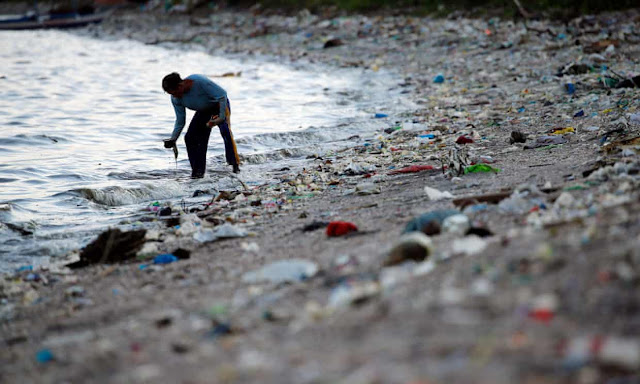
A man collects recyclable materials along Manila Bay, Philippines. A case against the country’s government could set an important precedent. Photograph: Francis R Malasig/EPA

A series of lawsuits against plastic producers and governments is expected after a “historic” international agreement on waste, say legal experts.

Last week, world leaders agreed to draw up a legally binding treaty over the next two years that covered the full lifecycle of plastics from production to disposal. The move was described by the head of the UN Environment Programme as the most important multilateral environmental deal since the Paris agreement in 2015.

And, like its climate counterpart, the new treaty could provide an essential tool to hold governments and companies accountable for their environmental impacts.

An imminent case in the Philippines could set an important precedent. Last year, a coalition of individuals and environmental groups led by the marine conservation group Oceana Philippines filed a petition accusing the Philippine government of failing to tackle the “unabated production, use and disposal of plastic” over the past two decades.

The group claims a law requiring the country’s public waste body to review, update and enforce a list of products that are not environmentally friendly has never been implemented despite being passed in 2001. The result of this, it say, is “the unabated emission of millions of tons of plastic waste into every nook and cranny of the Philippine archipelago”.

The petitioners, who include people who are catching fewer fish, having trouble conceiving or being affected by worsening floods aggravated by plastic pollution, say the government’s inaction is breaching their constitutional right to a healthy environment.

The Philippine supreme court has accepted the case, which goes to trial later this month.

Carroll Muffett, the president of the US-based Center for International Environmental Law, said it was “beyond any doubt” there would be more lawsuits on plastics in future, pointing to the “small but accelerating” body of litigation already in North America.

The coffee company Keurig Green Mountain recently agreed settlements in both the US and Canada with a consumer and regulator respectively after being challenged on claims about the recyclability of its disposable coffee pods. The company paid out millions of dollars and has to change the language it uses on its packaging.

Earth Island Institute, a California-based environmental group, has filed three separate lawsuits against producers of plastic goods. 
In 2020, it began suing Coca-Cola, Pepsi, Nestlé and other large companies for creating a plastic pollution “nuisance”. 

The following year Earth Island Institute brought another lawsuit against Coke as well as BlueTriton Brands (formerly Nestlé Waters North America), claiming the companies falsely portrayed themselves as environmentally friendly despite being huge plastic polluters. 

The companies argue they are all taking action to reduce their plastic use, improve collection and try to find policy resolutions with legislators. The Guardian - link - Isabella Kaminski - link - more like this (plastics) - link - more like this - link